Thursday, May 22, 2014

Indian Christians Under A Narendra Modi Led Government

The controversial track record and role of BJP's (India's right wing, Hindu nationalist opposition party) prime ministerial candidate Narendra Modi, with respect to India's largest minority community namely the Muslims, has been a matter of intense introspection ever since the 2002 Gujarat riots, which saw over 2000 people being killed and lakhs getting displaced. The omissions and commissions of the BJP led state government under the chief-ministership of Narendra Modi came under severe criticism not only from the Supreme Court of India and the apex body for human rights-the National Human Rights Commission (NHRC) but also from the then Prime Minister of India and undisputed leader of the BJP, Atal Behari Vajpayee, who described the 2002 riots as a “blot on Indian democracy”! Several intellectuals, liberals and those opposing the idea of communal politics have written, debated and elaborated upon the misgivings, many of them justified, that the Muslim minority community continues to harbor towards Mr. Modi and the BJP.

What hasn't drawn as much attention however, quite unfairly one must add, is the outlook of the BJP, its affiliates and its current poster-boy Mr. Modi towards India's third largest community- the Christians. Come 26th  of May 2014 , India will have a new Prime Minister and it's important to understand what the new government's approach towards Christians could be. This is a question, that can perhaps be answered, based on experiences of BJP  led governments and from an academic research into their ideological moorings.

A Historical Perspective:

The Sangh Parivar or the “family of organizations”, inspired by the ideology of the Rashtriya Swayamsevak Sangh (RSS), an Indian variant of the Klu Klux Klan, represents the Hindu nationalist movement, whose ultimate aim lies in transforming India into a theocratic Hindu Rashtra or Hindu state. It comprises of Bhartiya Janata Party (BJP)- which is the political outfit,  Bharatiya Kisan Sangh , literally,  Indian Farmers' Association Bharatiya Mazdoor Sangh , i.e. the Indian Labour Association Akhil Bharatiya Vidyarthi Parishad or the  All India Students' Forum Bharatiya Janata Yuva Morcha - Youth wing of BJP, Swadeshi Jagaran Manch which is the  Nativist Awakening Front , the  Vishwa Hindu Parishad or the  World Hindu Council and perhaps the most militant of them all- the Bajrang Dal , whose members have been involved in acts of violence against Muslims in various riots, desecration of churches and most notably the gruesome murder of Australian Christian  missionaryGraham Staines and his two sons.

M S Golwalkar, perhaps the most revered chief of the RSS, who is fondly remembered as “Guruji” (Teacher) by his ideological foot soldiers, reveals the outlook of the Sangh Parivar towards Christians in his second book,  Bunch of Thoughts where he devotes Chapter XII to three "Internal Threats" namely Muslims, Christians and the Communists! He further writes about Indian Muslims and Christians that: "Together with the change in their faith, gone are the spirit of love and devotion for the nation. Nor does it end there. They have also developed a feeling of identification with the enemies of this land. They look to some foreign lands as their holy places.”

Another celebrated figure in the Sangh Parivar narrative is V.D Savarkar. In his book “Hindutva” he groups Indian Muslims and Christians together as ones who do not share "the tie of the common homage we pay to our great civilisation - our Hindu culture." He adds: "Christian and Mohammedan communities who were but very recently Hindus cannot be recognised as Hindus since their adoption of the new cult they had ceased to own Hindu civilisation ( Sanskriti ) as a whole... For though Hindusthan to them is Fatherland, as to any other Hindu, yet it is not to them a Holyland too. Their holyland is far off in Arabia or Palestine."

This world view of Indian Christians, who much like Indian Muslims, are perceived as “outsiders” or “foreigners” continues to be the guiding political narrative of the entire Sangh Parivar even today. After one of the worst anti-Christian riots in India in 2008 in the state of Orissa, where the BJP was in power in the state government along with a regional party, VHP-Bajrang Dal activists took the lead in provoking violence that lead to over 75 deaths, thousands being displaced and hundreds of churches being burnt down. Manoj Pradhan, a BJP legislator, was even convicted in 2010 for his role in the riots! Yet , the topmost leadership of the BJP, including its former President Venkaiah Naidu, virtually justified the riots by terming “conversions as the root cause of violence and social disturbances” and saying that a “strong federal law to prevent religious conversion across the country would be brought” if BJP regained power in the general elections expected to be held in 2009!

Unfortunately, Mr.Modi has never come out in public to reject the exclusivist world view of the RSS with respect to Christians in particular and minorities in general. When asked about his views in this regard in a recent interview on ABP news, Modi simply evaded the question.

Christians under Mr.Modi's government in Gujarat

In another television interview in April 2014 , a question was posed to Mr.Modi on what steps he would take to ensure no churches are broken down if he becomes Prime Minister to which he replied, to the utter shock of many, that he had never heard of such incidents taking place! This prompted Richard Howell, general secretary of the Evangelical Fellowship of India, which represents about 45 churches across the country to angrily retort “How can he forget the gruesome attacks on tribal Christians in Gujarat's Dangs district in 1998 during the NDA regime when members of the Right-wing cadres burnt down churches? Atal Bihari Vajpayee, then Prime Minster, himself had visited the district to take stock of the situation.”

Perhaps this is why when there were several protests in front of City Hall in Ahmedabad about an ancient Christian cemetery being desecrated in Sabarmati no action came about against the perpetrators, suspected to owing allegiance to the Sangh Parivar.

Tehmina Arora, an attorney from New Delhi in her recent  Testimony before the Committee on Foreign Affairs' Subcommittee on Africa, Global Health, Global Human Rights and International Organizations in the U.S. House of Representatives speaks about how anti-conversion laws, co-incidentally enacted in the states primarily ruled by the BJP, were being misused often to “target and harass Christians.” She adds “The law in Gujarat state requires that the person seeking to convert to another religion must take prior permission from the district magistrate before any conversion “ceremony” is performed. The Acts, therefore, greatly impinge on the freedom of conscience of a prospective convert, and also on their right to privacy. The law renders the person incapable of taking the final decision with regard to his or her faith, and instead requires approval of the district authority.This is an invasion of the privacy and violation of both international law and the Constitution of India. This is violation of the right to freedom of association, the right to privacy and the freedom of conscience.”

An example of this was evident when in March 2012 the Gujarat High Court, in a significant judgment, restored the marriage license of a Marriage Registrar, which had been wrongfully revoked for formalizing a marriage between a Christian and a Hindu, by the Narendra Modi government, which invoked the notorious Freedom of Religion Act 2003-Gujarat's anti-conversion law.

In the same testimony Tehmina also states “Over the past five years, attacks have been reported across the country, though primarily concentrated in the states where the Hindu nationalist Bharatiya Janata Party (BJP) has been in power and where groups associated with his party have been active. Violence is fuelled primarily by non-state actors who are guided by the Hindutva ideology, which sees India as a Hindu nation, where religious minorities are second class citizens.”

Mr. Modi's personal antipathy towards Christians was most obvious after the 2002 riots when he constantly emphasized on the Christian name of the Chief Election Commissioner James Lyngdoh (who ironically is an atheist) in his speeches for taking a decision to delay elections in Gujarat back then. At a public rally near Vadodara Modi thundered : “Some journalists asked me recently, ‘Has James Michael Lyngdoh come from Italy'' I said I don't have his  janam patri (birth certificate) , I will have to ask Rajiv Gandhi. Then the journalists said, ‘Do they (Lyngdoh and Sonia Gandhi) meet in church?'' I replied, ‘Maybe they do'.”

The 'International Religious Freedom Report 2003' released by the Bureau of Democracy, Human Rights and Labour of the US State Department exposed how the Gujarat government had aggressively surveyed Christian families and Christian agencies during the reporting period, allegedly under the orders of Chief Minister Narendra Modi. “The survey activities were carried out by police, often in the middle of the night. The survey was first taken up in February, which continued through May” it added. This, even after the Gujarat High Court's ruling in March that such a survey was illegal. Apparently, the survey included questions about the number of converts in the household or parish, the circumstances of conversion, and the sources of funding received from abroad, etc.

In October 2002, Gujarat's senior cabinet minister and a colleague of Narendra Modi, Karsan Patel, publicly threatened 400 tribal children, who were boarders at a Christian school in Subir "to decide whether they want to live as Hindus or die as Christians". No action was taken against him.

It's not surprising then, given the silent persecution of Christians in Gujarat, that their already miniscule population (about 0.56% in 2001) has fallen by 5% in entire decade whilst Modi was at the helm of affairs.

Christians under various BJP led governments

A report compiled in 2011 shows there have been 172 incidents across the country in which Christians have been attacked. Karnataka, under BJP rule back then, topped the list with 47 incidents followed by Odisha, which in 2008 had witnessed anti-Christian violence led by Sangh Parivar groups, witnessed 25 incidents and coming in at third position was another BJP ruled state of Madhya Pradesh with 15 incidents! BJP legislator from Karnataka Prahlad Remani even went to the extent of stating that  “People must remain aware and watchful about the spread of these seeds of Christianity,” and that “Christianity must be weeded out of Karnataka” . The sentiments were echoed by VHP's Pravin Togadia who declared in Ahmedabad that they shall declare Gujarat a “Hindu State” by 2015!

In 2003, the RSS mouthpiece, Organiser, printed a vicious attack on Mother Teresa in its special issue written by N.S. Rajaram. The article began by arguing that the Indian government should not send any representative for her beatification ceremony. It then went on to say that all the Church is known for these days is "mass child molestation, homosexual priests and even murders".

Not to be outdone in this quoting the scriptures of hatred against Christians, the Vishwa Hindu Parishad Vice-President , Acharya Giriraj Kishore, termed Pope John Paul II as a ‘big dacoit' who was “ changing the demography of India through illegal conversions.”

In its hard-hitting piece titled “An assault on Christians” in July 2000, a leading magazine Frontline reported that “A wave of attacks against Christian evangelists and places of worship through 1998 culminated in the murder of the Australian missionary Graham Staines and his two sons on January 23, 1999 by Dara Singh, a Hindutva fanatic with links to the Sangh Parivar,who had been arrested in that connection. “ It further added that “A second wave of terror against Christian missionaries, that now extended to the States of Uttar Pradesh, Haryana, Punjab and Andhra Pradesh, had culminated in a series of bomb blasts in churches in Karnataka, Goa and Andhra Pradesh.”

All of this was happening under the wakeful watch of a BJP led-RSS bred central government in Delhi.

While the BJP off late, under its relatively moderate faces like the chief minister Manohar Parrikar from Goa, does flaunt the fact that it has six Christian elected legislators in a House of 40 members in a state that has almost 30% Christian population, it hardly re-assures those like Pastor Christopher of Hyderabad who reveals to the International Christian Concern that "There have been continuous threats from Hindu radicals,” and how “Christians continue to be treated as second class citizens in this country." Having received several threats over the last 15 years, Pastor Christopher says that he was once threatened by RSS to stop all church activities or else they would "chop him into pieces!"

The influence of the Sangh Parivar in the sphere of communalizing education in state governments run by the BJP is also well known. The one-man committee of academic Francis D'Souza outlined several examples of "saffron tint'' in textbooks from Class V to IX published under the imprint of the Karnataka Textbook Society (KTS) during the BJP regime. Francis D'Souza was shocked to report that it wasn't just History text books but also Science text books that were distorted by unscientific myths perpetrated by the Sangh propaganda machinery.

The Road Ahead

In June 2013, a few months before Narendra Modi was officially anointed as the prime ministerial candidate of the BJP, the RSS chief Mohan Bhagwat, in what looked like his strongest endorsement for Modi said that “whether somebody likes it or not, Hindutva is the only way to bring about a change in the country. It is where the country's respect lies.” Two months later, in Kolkata, Mohan Bhagwat stressing on the need of “Hindus having an aggressive, nationalistic stand” stated that Modi was the only person who had remained “rooted” in the RSS ideology. Modi, who has been a RSS functionary from a very young age, has revitalized the RSS. According to independent reports, in less than 3 months after his announcement as the BJP's PM candidate over 2000 shakhas (branches) of RSS sprung up all over India. It's clear that the RSS is pinning all its hopes on Modi and even unleashed its entire organizational and propaganda machinery to run his campaign. In return, the RSS expects that their long, unfulfilled agendas would see fruition under a Modi-led government.

A few of the RSS agendas even found their way in the BJP manifesto, with renewed vigour, this time around. This includes their favorite themes of pursuing a uniform civil code in India- which invariably hinges on the plank of stifling non-Hindu religious and cultural freedoms, abolishing Article 370 that gives autonomy to the state of Jammu and Kashmir, building the Ram Temple at Ayodhya, cow protection, etc. In fact, the manifesto even declared India to be a “natural home for persecuted Hindus” who shall be “welcome to seek refuge here.” So a Nepali Hindu could very well make India his home but if a Keralite Christian with a UK passport was being persecuted, he wouldn't get refuge in India as per the current formulation in the BJP manifesto.

The ultimate agenda of the RSS is to see the creation of a Hindu Rashtra or a Hindu state. This would require the “undoing” of the current Constitutional scheme of “secularism” – an idea which has always been under attack by the Sangh Parivar. The RSS would require a Modi-led government to systematically “harmonize” independent institutions that can pose a challenge to the accomplishment of this goal.

Firstly, the RSS would require a Modi led BJP to get a majority in Parliament so that he can amend the Constitution accordingly. Since, “secularism” is a part of the “basic structure” of the Constitution and has been put out of the bounds of legislative amendment by the Supreme Court in its earlier judgment, the RSS will also need the executive government to ensure, perhaps through amenable appointments, that the Supreme Court goes along with the proposed changes to the Constitution itself. To those who find this to be far-fetched, may I remind you about the “National Commission to review the working of the Constitution” set up by the BJP government under Prime Minister Vajpayee. It's quite another thing that the BJP never ended up getting the majority in Parliament they were expecting to push these agendas through back then!

But this time around, with Modi securing a majority in Lok Sabha, the RSS will seek the completion of its "unfinished agenda". The potential next steps would be, as a senior leader of the BJP who draws all his backing from the RSS -Dr. Subramanian Swamy suggests, to disenfranchise the non-Hindu citizens of India. This would require the “taming” of the Election Commssion of India too, which has co-incidentally been on the radar of the BJP in the last few weeks. Recently, top RSS ideologue told the Hindu newspaper that Modi is expected to deliver on the Ram Temple and the RSS means business when it says that. Once these long cherished goals are attained, it would become easier to facilitate socio-economic and socio-cultural changes that would be needed to transform India into a theocratic Hindu state, ironically modeled on the same exclusivist plank that led to the creation of Pakistan as a “homeland for only Muslims”.

In this mission, the RSS would obviously need a supportive media that does not question its agendas or create roadblocks and hence Narendra Modi's assistance- governmental and otherwise, would be sought to co-opt or intimidate the owners of media groups and intellectuals into playing along with them. Already, we find that many a media organizations, thanks to their varied business interests,prostrating before Narendra Modi, even before he has been sworn in as Prime Minister.

Those who think only Muslims ought to be cautious about Mr.Modi, think again! Evidence suggests that Christians too will have to brace themselves up for a rather challenging period as Modi's "majority government" exhibits "majoritarian symptoms".

Mr. Modi's campaign slogan reads “Good days are near!” Ironically, it is this very lure of a “great days ahead” that blinded Germany into seeing Hitler as their leader and ignoring what he truly represented. One can only hope and pray that India doesn't go down the same path.

Shehzad Poonawalla is a 1st generation, self-made, 26 year old, lawyer-activist engaged in politics and civil rights movement. He is the youngest Additional Private Secretary to Ministry of Parliamentary Affairs, Govt of India.

Tweet @Shehzad_Ind
Email: shehzadpoonawalla@yahoo.com

Wednesday, May 21, 2014

Dalits allege harassment over participation in church festival

Tiruchi: Over 50 dalit people have complained to Tiruchirapalli district Collector about police harassment following a dispute over their participation in the annual car festival of a church in the Periyavarseeli village.
The villagers came from the neighboring Pokkattakudi Seshasamudram near Lalgudi town on May 13 after police allegedly beat them up over the weekend.
The trouble began on Saturday after a few caste Hindus youths of Periyavarseeli village reportedly told the dalits that they should not participate in the car festival of the Adaikalamatha Church held last week.
The dalits had returned after the incident, but some of them had questioned a youth who visited their village on Sunday. A police constable on patrol, the villagers alleged, had intervened and assaulted the dalits without any enquiry.
“We were just talking to the youth in a friendly manner asking him about the reason for being told to stay away from the festival. But the constable started attacking us. Some of us objected to his action and there was a scuffle. The constable called up his colleagues and 10 to 15 policemen descended on the scene and attacked us indiscriminately,” said N.Mohan, one of the villagers.
However, police claimed there was a scuffle between the two groups necessitating the intervention of a police constable on patrol. The villagers had taken objection to this and attacked him, a senior police officer said.
Cases have been registered against 11 persons in connection with the incident and two have been arrested.

Click here for source

Sunday, May 18, 2014

India's Christians fear rise in persecution under BJP

After the BJP's historic election victory this week, Christians in India have mixed feelings about the future and how the country's new leaders will impact on freedom of religion.

The last week has been a massive turnaround for the once struggling opposition party that suffered defeats in the last two elections.

Taking them to victory was the charismatic Narendra Modi, who International Christian Concern reports has feigned ignorance about past Hindu nationalist attacks on minorities.

There are serious concerns among Christians, with one pastor, Ronald John, telling ICC the "persecution of Christians will increase under the BJP-led government".

"Christians already are gripped with fear and concern over the election results. Hindu nationalist groups will take advantage of the situation and use it to attack churches and members of the Christian community," he said.

CA Daniel, president of the National Congress of Indian Christians, made similar comments to ICC, saying Christians are "not safe" under BJP rule.

"There will be stringent rules and legislation restricting Christians and the exercise of the freedom of faith," he said.

Dr John Dayal, secretary general of the All India Christian Council, recalled the scale of devastation perpetrated by Hindu radical mobs when they went on the rampage in Kandhamal, Odisha, and Mangalore, Karnataka, in 2007 and 2008 killing over 120 Christians and Dalits. Over 300 churches and more than 6,000 Christian homes were destroyed in the attacks.

"We will have to find out how we can tell the new government [about] our problems and fears, our expectations of a strong secular government, and hold it accountable for its misdeeds whenever it falters in giving [Christians] security and the freedom of faith," he told ICC.

ICC's regional manager William Stark said Christians in India were already experiencing restrictions on the free exercise of their faith.

"Forced conversion laws manipulated to attack Christian pastors and a climate of impunity for perpetrators of violence against Christians has been a hallmark of BJP rule at the state level," he said.

"This must not be allowed to take hold in India's national government. Positive action must be taken to ensure the rights of all of India's citizens, including Christians, are respected and enforced."

Click here for source

Thursday, May 15, 2014

Christian Arrested in Chhattisgarh

Police arrested a Christian on 22 March in Pinakapar, Balod after the Hindu extremists from the Bajrang Dal falsely accused him and one believer of breaking idols in the local Hindu temple.
Our correspondent, Rev. Akhilesh Edgar reported that the Hindu extremists summoned a follower of Christ, Guman Devdas and one believer to a village council meeting and pressurized them to renounce Christ and further accused them of breaking the Hindu idols.
However, the Christians refused to deny Christ and they also refuted the allegations of breaking the idols.
Thereafter, the extremists went to the police station and demanded the arrest of the Christians. A case was registered against them under Section 295 and 456 of the Indian Penal Code for Injuring or defiling a place of worship and trespass or house breaking respectively.
Devdas was sent to the district jail. However, the other believer has absconded.
The area Church leaders are taking steps to get bail for the Christian. Kindly pray.

Source: EFINEWS

Wednesday, May 14, 2014

Pastor Accused of Forceful Conversion, Vehicle Damaged in Karnataka

On 4 May in Bagath Sing Nagar, Davangere, Hindu extremists damaged the vehicle of a pastor after they filed a police complaint against him of forceful conversion.
Our correspondent, Moses Muragavel, Allied Attorney of ADF, India reported that, instigated by the Hindu extremists, Ganga Naik filed a police compliant against his brother Pastor Chandra Naik from Living Hope Gypsy Church of forceful conversion.
The complaint letter was signed up by 25 people to take legal action against Pastor Chandra Naik .Thereafter, First Information Report was filed against Pastor Naik at K T J Nagar police station. The case is pending before the court.
In the meantime, anti-Christian people have pelted stones at Pastor Chandra Naik's Omni Van and partially damaged it.
Speaking to EFI News, Pastor Chandra Naik said, "There was no case of forceful conversion, people come to the church to pray by their own decisions."
The Christian submitted a counter complaint against the extremists at K T J Nagar police station with the help of ADF, India. Moreover, the PSI promised the Christians that he will give police protection on the following Sunday worship meeting.
Kindly pray that Pastor Chandra Naik will be able to minister in the area peacefully.

Source: EFINEWS

Sunday, May 11, 2014

Life a nightmare again for Orissa Christians says Indian churches' leader

Life is becoming a nightmare again for many Christian communities in the Indian state of Orissa, scene of the worst anti-Christian persecution in India's history in 2008, says a national Christian leader.

Life is becoming a nightmare again for many Christian communities in the Indian state of Orissa, scene of the worst anti-Christian persecution in India's history in 2008, says a national Christian leader.

Sajan George, president of the Global Council of Indian Christians (GCIC) said that some parts of the state, many Christian families have seen their newly-rebuilt homes destroyed, the Roman Catholic AsiaNews has reported.

Extremists, said to be ultra-nationalist Hindus, have driven many Christians from their villages, forcing them to give up water, property, and other essentials.

George spoke to AsiaNews about new acts of "intimidation and persecution against Christians," noting that the situation has been "made worst by the complicity of local police and administrators."

In August 2008, Christians in Orissa, especially in Kandhamal, 250 kilometres (150 miles) from Bhubaneswar, said they had faced what they describe as orchestrated attacks by Hindu mobs, since the killing of Hindu leader Swami Laxmanananda Saraswati in August.

A Maoist leader was reported to have claimed responsibility for the killing but some Hindu groups said it was a Christian conspiracy, as the 85-year-old slain monk had been campaigning against conversion to Christianity in Kandhamal, where he was based.

More than half the 100 000 Christians in Kandhamal were left homeless as a result of the extremists roaming villages, and trying forcibly to convert Christians to Hinduism, whilst looting and torching Christian houses.

George said on May 3, that the Global Council of Indian Christians wants the government to treat the victims of anti-Christian pogroms in Orissa the same way as it has treated survivors of the riots between Hindus and Muslims in Gujarat in 2002.

GCIC president George said he wants the government to give "the same concessions to those who suffered from [anti-Christian] pogroms."

In particular, he cited "the children and dependents of victims of anti-Christian violence that occurred in the district of Kandhamal (Orissa) in 2008."

"Besides suffering persecution on religious grounds, these people belong to the most marginalised groups in society since most of them are Dalits [who were once classified as 'untouchables' under the caste system] and tribals," Sajan explained.

The Christian leader said that what happened in Kandhamal in August 2008, "is without a doubt the most painful and terrible chapter in the history of India. Innocent Christians were brutally targeted and mercilessly killed. Their homes, places of worship and places of work were destroyed. The wounds of that terrible tragedy cannot be easily erased."

Click here for source

Tuesday, May 06, 2014

Defeat communal forces, elect ‘secular politicians’: Andhra Pradesh church body to Christians

Hyderabad: Bishops and church heads in Andhra Pradesh have asked all Christians to vote for secular leaders in the upcoming May 7 elections in Seemandhra.
The Andhra Pradesh Federation of Churches has issued a ‘Pastoral Letter’ urging voters to elect leaders who are secular, sincere and free from crime and corruption and communalism.
The letter would be read on Sunday, in all the churches in Seemandhra. The religious body, however, has not named any politicians.
Christians, though in minority, form an important part of voters in Andhra Pradesh.
“We need to elect leaders who are close to people and respond to their needs; who strive for social justice and equality of the marginalised groups like the tribals and Dalits especially Dalit Christians and protect the rights of the minorities; who are determined to advance an inclusive economy that supports the poor especially to (sic) the unorganized labourers and marginal farmers by ensuring their basic human rights to food, water, shelter, health, education and employment; who strive to ensure the safety and security of women and children and their essential rights to life and livelihood; who lay focus on youth for ensuring their holistic development with character building, critical education and life skills; who make every effort to curb corruption and bring about good governance with peoples’ plans and decentralized, transparent, accountable and responsible administration; and who endeavour to protect the environment with sustainable development and (to) safeguard the rights of Tribal and Local communities over land, water and forests,” the letter says.
 “We are deeply concerned about the pressing needs of our Christian Community in State,” the letter goes on. “Our State records one of the highest numbers of atrocities committed on Christians and pastors. During the recent months these attacks have increased in some districts. Organized mob attacks are taking place on Christians during their worship.”

Click here for source

Sunday, May 04, 2014

Ostracised, Christians in Orissa again see their homes destroyed and water wells poisoned

Mumbai (AsiaNews) - Daily life is becoming a nightmare again for many Christian communities in the state of Orissa (Odisha), scene of the worst anti-Christian pogrom in India's history in 2008, this according to Sajan George, president of the Global Council of Indian Christians (GCIC). In some parts of the state, many Christian families have seen their newly-rebuilt homes destroyed. Many of them have also been driven out of their villages, forced to give up water, property, and other essentials.

George, who spoke to AsiaNews about new acts of "intimidation and persecution against Christians," said that the situation has been "made worst by the complicity of local police and administrators." One of the latest episodes occurred during the week before Easter in the village of Budruka.

Here, a local Christian, Praful Digal, had his house destroyed by a fire set by a group of Hindu extremists. His original home had been destroyed during the violence of 2008. Later, with government compensation money, he was able to rebuild. Now he lost it again.

After he and his family filed a complaint with the local police, Sudershan Mallick, Mallick and Pabitra Mallik Nageswar were arrested in connection with the fire. However, on 25 April, the three were released.

Things are even worse for three Dalit Christian families - Manasida Barla, Masid das Lugun, and Lodha Barla - and their 16 members. They live in an area inhabited by tribal people where Naxalite (Maoist) insurgents are very active.

In the name of religion, they were driven out of their village by the hundred or so Hindu families that live there. The latter also took away what they had "because they were believers and followers of Christ."

The neighbours threw garbage and other waste in the well used by the Christian families in order to deny them water; they also banned them from mixing and speaking with other residents, or take part in any community programmes and initiatives.

"In addition to this kind of torture, some Hindu extremists are threatening to strike the families' names off a government list for land allotment, to seize the land they already own and tear down their homes," Sajan George said.

"How will these families survive without water, now that hot weather is approaching with temperatures that can reach the mid-40s Celsius.

Click here for source

Saturday, May 03, 2014

Christians in Orissa suffer abuse and intimidation

Christians in Orissa who survived the violence in 2008 cannot find peace and are still victims of abuse and intimidation, Catholic priest Fr Ajay Kumar Singh, stated this week. Fr Singh, who received an award for his work among the victims of the 2008 pogroms in Kandhamal in Orissa, said that recently the police arrested and then released three people accused of having destroyed the home of a Christian family who survived the massacres of 2008.
Praful Digal, a Catholic from the village of Budruka, had rebuilt his home thanks to aid received by the government for the reconstruction. Radical Hindu groups attacked the new house, razed it to the ground. Fr Pradosh Kumar Nayak, Rector of the Minor Seminary of St Paul in Balliguda near Budruka confirmed that the attack had taken place. After the family filed a complaint, the police arrested Sudershan Mallick, Pabitra Mallick and Mallick Nageswar, but the three were inexplicably released.
Fr Nayak pointed put that this is the third house the Digal family have built over the past six years. Hindu radicals have demolished all of them.
"The last demolition shows that these groups are strong and determined to keep Christians out of the country. Christians continue to lead a terrible life in Kandhamal district" Fr Nayak said.
The Digal family was among the 834 whose homes was destroyed in the first round of anti-Christian violence in Kandhamal which took place in December 2007. The family took courage, returned to the village and rebuilt the house, which was again destroyed in the violence in August 2008. After years of exile, in recent months and after having received compensation from the government, the Digal decided to return to their village again and start a normal life. But this new attack has shattered their hopes.
Fr Singh said : "The State has failed to protect and guarantee the basic rights to Christian citizens in Orissa".
Source: Fides
http://www.indcatholicnews.com/news.php?viewStory=24652

Thursday, April 24, 2014

Tribals torn apart by religion

Two months before polling began in Jharkhand, Ajay Tirkey began dividing his day between campaigning for the Bharatiya Janata Party in Ranchi and attending to his real estate business. Mr. Tirkey, who heads the Central Sarna Committee(CSC), with lakhs of animistic Sarna tribals as members in urban parts of Ranchi, Gumla and Hazaribagh,believes that the BJP’s Narendra Modi will get the community what it has been demanding for decades: the distinction of being a minority religion with all attendant benefits. “We submitted a memorandum to Modi in December to introduce a Sarna code in the census, and [the] BJP’s State leaders agreed,” he says.

Mr. Tirkey — tall, stout, dressed in white shirt and trousers and wearing a golden watch on one wrist and a vermillion thread on the other — speaks softly and smiles often, even while narrating the violence that has broken out following his organisation’s attempt to stop religious conversions in the last decade. The office of his company, Deoshila Development Private Limited, is sparsely furnished, with only a poster of Hanuman for decoration. Mr. Tirkey owns the commercial complex we are sitting in. “This is a century-old fight. I have not let the Christians get away with conversions since I became the head in 2000,” he says. “We broke the walls of a church in Tape in Ormanjhi while it was being constructed. There was a case of conversion of five families in Ghagrajala village in Ranchi; we re-converted three. Then a few families in Gaitalsud, Angada, of whom only one member escaped because he worked somewhere else. He has not come back since; he fears us,” he recounts, beaming.

Mr. Tirkey, the BJP’s mayoral candidate from Ranchi in 2013, describes the “re-conversion” ceremonies as being similar to the ghar-waapsi (homecoming) ceremonies conducted by BJP leader Dilip Singh Judeo in Chhattisgarh, in the mid-2000s. Mr. Judeo used to wash the feet of the converted person with holy water and declare the person Hindu again. Sarnas, Mr. Tirkey says, besides washing feet, made the converted person taste a drop of blood of a freshly sacrificed rooster and sprinkled water on them. A member of the Rashtriya Swayamsewak Sangh’s Vanvasi Kalyan Ashram (VKA) or Dharam Jagran usually accompanied CSC members for this ceremony, he says. Sitting by Mr. Tirkey’s side, Manoj Kumar, a member of the BJP’s Jharkhand Kisan Morcha Pradesh Samiti, nods in agreement.

Conversion politics
In the last century, religious conversions in the Chotanagpur region have led to tensions. The first missionaries to arrive were the German Protestants in 1845, followed by the Catholics. The rift between Christian and non-Christian tribals was visible in 1947-48. Concerned with the growing influence of Christians, Sarna leaders formed a ‘Sudhar Sabha,’ notes academic Dr. Alex Ekka in an essay on the Jharkhand movement.

The former captain of the Indian hockey team, Jaipal Singh Munda, is credited with getting equal rights including reservations for Christian tribals, as a member of the Constituent Assembly. A few Sarna leaders opposed this move then. Congress MP Kartik Oraon introduced a bill in Parliament in 1968 to de-schedule Christian tribals, albeit unsuccessfully.

The Jan Sangh and the RSS began making inroads in the Chotanagpur region in the 1960s, initiating developmental activities in forest villages to counter the growing reach of Christian missionaries. While the VKA already has a strong presence in the Gumla and Latehar districts of West Jharkhand, more recently it has focused on increasing its influence in Sahebganj and Pakur along the State’s border with West Bengal, close to Bangladesh. Both districts feature in a map of areas from Uttar Pradesh to the north-east as “Areas of high Muslim and Christian influence” in a publication by Sankat Mochan Ashram, New Delhi.

“The church was trying to proselytize in Pakur but slowed down after we increased our presence. We recently performed ghar-waapsi for 50 families there. Sarna groups are doing re-conversions themselves now; we prefer it this way. We explain to them that 2000 years ago, we worshipped trees. Sarnas are Hindu too,” says Prakash Kamat, the Bihar-Jharkhand zonal secretary of the VKA.

Tribals constitute 26.3 per cent of Jharkhand’s population. According to the 2001 Census, of the State’s population of 3.29 crore, 68.5 per cent are Hindus and 13.8 per cent are Muslims. Only four per cent follow Christianity. Though Sarnas, who worship their ancestors and nature, are not counted separately, they make up most of the ‘Other’ category, estimated at 11 to 13 per cent of the population. Sarna groups claim that the actual numbers may be higher, given the absence of a separate category for them. A common perception is that despite their small numbers, Christian tribals have better access to higher education and jobs. Whether due to economic disparities or the stoking of enmities by different religious groups, the chasm between Sarna and Christian tribals has widened.

A deep divide
The most stark instance of this was in 2013 when a spate of protests erupted in Ranchi soon after the Cardinal Telesphore Toppo unveiled the statue of a “tribal” Mary — a dark-skinned Mother Mary wearing a white and red saree and bangles, holding an infant Jesus in a sling, as is common among tribal women. Sarna dharamguru Bandhan Tigga, considered more moderate than Ajay Tirkey’s group, gave the Church three months to remove the statue, describing it as a conversion tactic. In August, over 3,000 Sarna tribals marched to the site, a small Catholic church in Singpur on Ranchi’s outskirts, threatening to bring it down. The police imposed Section 144 of the Indian Penal Code in the area to stop the protesters. Three days later, a FIR was registered against members of Sarna groups after they threatened families in Ormanjhi, 50 km from Singpur, who had converted to Protestantism several years ago, to re-convert to Sarna religion within a week, even breaking the gate of the house of one of the families.

Sources close to the Cardinal claim he had not known that the statue was that of a “tribal” Mary before he reached the parish for the inauguration, but have chosen to stay silent, fearing that a step back now may only weaken the church’s position. Before this, in 2008, the church was on the back foot when Sarna groups questioned the ‘Nemha Bible’ published by a Lutheran church in the tribal language, Kuduk, which they said contained portions offensive to animistic worship.

In Singpur, the residents still recount last year’s protests cautiously. “Thousands marched from Dhurva to the parish. While the march had been called by Sarna groups, several Bajrang Dal members wearing saffron bands marched with them. Even tribals from neighbouring Odisha, Chhattisgarh districts reached here,” recalled a member of the community. It was done by evoking Sarnas’ pride, say Dharam Jagran members.

anumeha.y@thehindu.co.in


Click here for source

Thursday, April 17, 2014

Church leaders gun for ‘utter lie’ on Christian persecution

New Delhi, April 16: Christian leaders today condemned Narendra Modi’s statement in a television interview last week that he was unaware of any attacks on members of the community and their places of worship in India.

“What he said was an utter lie. The onslaught against Christians by Right-wing groups has always been cause for concern. The Bajrang Dal, the youth wing of the Vishwa Hindu Parishad, has been attacking members of the Christian community and vandalising churches across India,” said Richard Howell, general secretary, Evangelical Fellowship of India, which represents about 45 thousand churches across the country.

Expressing shock and dismay at Modi’s statement, the community leaders said the BJP’s prime ministerial candidate cannot win their trust if he feigns ignorance about their sufferings.

“How can he forget the gruesome attacks on tribal Christians in Gujarat’s Dangs district in 1998 during the NDA regime when members of the Right-wing cadres burnt down churches? Atal Bihari Vajpayee, then Prime Minster, himself had visited the district to take stock of the situation,” Howell told a news conference in Delhi today.

He said 22 churches were burnt in 2002 in Gujarat and several members of the community were attacked by VHP cadres. The VHP is part of the Sangh parivar.

Replying to a question from a member of the audience who asked him what steps he would take to ensure no churches are broken down if he becomes Prime Minister, Modi said: “I have never heard of such incidents taking place.”

Vijayesh Lal, national director, Religious Liberty Commission, said Christians continue to be attacked and their places of worship are being vandalised over the past few years in states like Madhya Pradesh, Karnataka and Chhattisgarh.

“Surprisingly, Modi pretends to be ignorant and unaware about such attacks on Christians. If this is the case then why should we trust his promises of a secular India as mentioned in the BJP’s election manifesto,” he asked.

Click here for source

Indian Elections: What Could They Mean for Minority Christians?

India is gearing up for the largest show of democracy on earth. Ahead of the national elections, the silent Christian community in India has become restive and alert.

An electorate of 814 million, a number greater than the entire population of Europe, is eligible to cast the ballot in the staggered polls (scheduled in nine phases from April 7 to May 12) to choose India's 14th Parliament.
The national alliance of all the mainline churches, the National United Christian Forum, has come out with an appeal. The Catholic Church (which accounts for two thirds of the 28 million plus Christians) has issued a voter guideline, and regional ecumenical Christian bodies have recently come out with similar advisories.
Two major alliances-the ruling United Progressive Alliance (UPA) led by the "secular Congress Party (that has ruled the nation for the past two terms) and the National Democratic Alliance, led by the Hindu nationalist Bharatiya Janata Party (BJP)-are the main protagonists.
Apart from these two main alliances, 25 or so regional parties make the combat tougher for each of the 543 seats in "Lok Sabha ("House of the People-the lower House of the Indian parliament) that will decide who will rule India for the next five years.
With the opposition alliance led by the BJP (known for espousing a Hindu nationalist agenda) being projected by the pre-poll surveys as the front-runner in elections that many expect to produce a fractured verdict, the Christian community has grown increasingly uneasy.
The Catholic Church issued a call for prayer "for divine assistance for all the citizens of India so that we may elect the best persons... uphold the democratic and secular character of our great nation and selflessly work for the peace and prosperity of all the people of India.
BJP's intense campaign for the 2014 elections has been built around Narendra Modi, chief minister of the western state of Gujarat, who is expected to become the prime minister in waiting. While the Hindu nationalist lobby hails Modi as an able administrator who can accelerate India's sagging economy, secular parties claim he is a polarizing personality. He carries the stain of the 2002 slaughter of over 1,200 Muslims in Gujarat-the homeland of Mahatma Gandhi-when Hindu mobs targeted Muslims following the torching of a train carrying Hindu pilgrims.
The inaction and even collusion of the police under Modi's command, coupled with his persistent refusal to express regret for the deaths, has made Modi the target of many secular groups.
"There is (also) a fear in the minds of (Christians), admitted Rev. Roger Gaikwad, general secretary of the National Council of Churches in India (NCCI), a network of 30 Orthodox and Protestant churches. "Some fear that difficult are days ahead.
The BJP has campaigned to foster better relationships with the Christian community, trying desperately to shed its "anti-Christian image. Two Bishops of the Malankara Orthodox Syrian Church praised Modi and his Gujarat model of development, but most Christians were angered by their support of Modi. Despite conciliatory gestures by the BJP, many Christians remain skeptical. States under BJP rule have historically witnessed a rise in incidents of anti-Christian violence, and some BJP State governments have been eager to push through anti-conversion legislation. BJP leaders are also known to have defended the assailants in brutal attacks on Christians and the rape of nuns.

Wednesday, April 16, 2014

Christians in southern India urged to boycott Hindu nationalist party

Christians in southern India have been urged to boycott the Hindu nationalist party, the BJP, in the country’s parliamentary elections in an unprecedented pastoral letter from church leaders including the Archbishop of Hyderabad, Thumma Bala.
The letter to Christians in southern state of Andhra Pradesh, India’s fifth most populous, was read in hundreds of churches on Palm Sunday and will be read out again before polling begins there on 30 April.
In the letter, the Andhra Pradesh Federation of Churches (APFC), an ecumenical council of bishops and church leaders, called on Christians to “elect leaders who are close to people and their needs, and only vote for those who uphold secular character and promote communal harmony”.
The letter was signed by Archbishop Thumma Bala and the moderator of the Church of South India, Anglican Bishop Govada Dyvasirvadam.
The BJP is the leading party in the opposition National Democratic Alliance (NDA), whose prime ministerial candidate, Narendra Modi, chief minister of Gujarat state, sees India as a primarily Hindu nation.
The NDA is currently leading the election and is the major non-secular party. All Christian and Muslim parties are considered secular, and most Christians and Muslim voters support the incumbent Congress party led by Rahul Gandhi.

Click here for source

Wednesday, April 09, 2014

Hindu American Foundation exposed as foe of human rights and religious freedom

Indian American coalition condemns HAF's sophistry "explaining" Hindu nationalist violence against minorities in India
 
FOR IMMEDIATE RELEASE
 
Washington DC, Monday, April 7, 2014

The Coalition Against Genocide (CAG - http://www.coalitionagainstgenocide.org/), today condemned the Hindu American Foundation for opposing the Congressional hearings on the plight of religious minorities in India and for obfuscating the issues around violence against minorities. As CAG has established in its recent report titled "Affiliations of Faith (Parts I and II)," HAF is primarily a front for the Hindu nationalist movement (also known as Hindutva) led by the RSS in India. Contrary to its claims about being a human rights organization, HAF has consistently served as apologists for the violent politics of the Sangh Parivar (the broad family of RSS organizations that includes HAF and its US based affiliates such as the VHP-A).

HAF's position on the plight of religious minorities in India is diametrically opposite to that of USCIRF, Human Rights Watch, Advocates for Human Rights, and also notable human rights activists like John Dayal. On its website and in social media, HAF has attacked the integrity of prominent organizations like HRW and USCIRF. This fits a pattern followed by Hindutva organizations where concern for minorities in India is projected as "bias" against Hindus.

"While any situation involving millions of people professing diverse religions is necessarily complex, violations of human rights and religious freedom as a result of the increasingly hostile socio-political environment created by the Hindu nationalist movement deserve international condemnation," said Mr. Alex Koshy, a CAG spokesperson. "It is deplorable that an organization claiming to stand for pluralism and human rights stridently opposes any scrutiny of the situation of religious minorities in India," added Mr. Koshy. "While being vocal about the situation of Hindu minorities in other parts of the world, HAF appears to be considering Christian, Muslim and Sikh religious minorities in India as somehow less worthy of having their plight known to the American public," said Dr. Raja Swamy, also a CAG spokesperson.

HAF touts its mission statement as "Promoting Human Dignity, Mutual Respect and Pluralism." Yet HAF's concern about the effect the hearings may have on the upcoming elections betrays its real priorities. In echoing HAF's concern about the timing of the hearing, Congresswoman Tulsi Gabbard appeared to be reading from an HAF script. At the very least, she could have sought a briefing from her staff on the evidence based data about the condition of religious minorities in India, and that H.Res. 417 is in fact a pro-India resolution that celebrates India's long-standing pluralistic ethos.

HAF's posturing against the hearings is reflected in its written testimony, graciously added to the record by Rep. Joe Pitts. A monumental exercise in apologetics for majoritarian violence in India, HAF claims for instance that the massacre of Christians in Odisha by Hindutva organizations, is to be blamed on the murder of a prominent Hindutva leader Swami Lakshmananda (who was killed by Maoists). Furthermore HAF blames anti-Christian violence perpetrated by the Hindutva movement as a response to "aggressive proselytizing by Christian missionary groups." When it comes to anti-minority violence conducted by the Hindutva movement, HAF consistently blames minority victims and tacitly defends the perpetrators.

HAF's alacrity in protecting Hindutva organizations from any kind of international censure for violence against minorities in India stands in stark contrast to its vigorous efforts to highlight the plight of Hindu minorities in countries around the world. Far from being an organization committed to promoting human dignity and pluralism, HAF stands exposed as a foe of human rights, working to defend the Hindutva movement from much needed public scrutiny in the US.

The Coalition Against Genocide is composed of a diverse group of organizations and individuals in the United States and Canada that have come together in response to the Gujarat genocide to demand accountability and justice.


CONTACT:
  1. Dr. Shaik Ubaid
    Phone: 516-567-0783

  2. Dr. Raja Swamy
    Phone: 864-804-0216

Coalition Against Genocide
Phone/Fax: (443) 927-9039
Email:media@coalitionagainstgenocide.org
http://www.coalitionagainstgenocide.org

REFERENCES:
  1. TLHRC Hearing: The Plight of Religious Minorities in India
    HEARING WEBSITE: http://tlhrc.house.gov/hearing_notice.asp?id=1259
    RECORDING: http://www.ustream.tv/recorded/45757005

  2. Affiliations of Faith: Hindu American Foundation and the Global Sangh (Part 1)
    http://coalitionagainstgenocide.org/reports/2013/cag.15dec2013.haf.rss.pdf

  3. Affiliations of Faith: Hindu nationalism and HAF - Joined at the hip (Part 2)
    http://coalitionagainstgenocide.org/reports/2013/cag.22dec2013.haf.rss.2.pdf

  4. Hindu American Foundation reveals its supremacist ideology through smear campaign against CAG and Indian Muslims
    http://www.coalitionagainstgenocide.org/press/cag.pr.06dec2013.pdf

  5. Hindu nationalism set to take over the world's biggest democracy, The Independent, UK, April 4th 2014
    http://www.independent.co.uk/voices/comment/hindu-nationalism-set-to-take-over-theworlds-biggest-democracy-9238724.html

  6. H.Res 417 -- Praising India's rich religious diversity and commitment to tolerance and equality, and reaffirming the need to protect the rights and freedoms of religious minorities.
    http://pitts.house.gov/sites/pitts.house.gov/files/documents/PittsEllison-IndiaReligiousFreedom.pdf

  7. BJP-led government to be detrimental to religious minorities: Experts
    http://articles.economictimes.indiatimes.com/2014-04-05/news/48887988_1_uscirf-religious-freedom-religious-minorities

  8. MN Rights Group Testifies at Congressional Hearing on the Plight of Minorities in India
    http://www.startribune.com/local/yourvoices/254049571.html

Monday, April 07, 2014

US expresses concern for minorities under Narendra Modi as PM

Washington: Several US lawmakers voiced concern Friday for the future of religious minorities in India in a hearing critics denounced as an attempt to influence upcoming elections.

With polls starting Monday in the world's largest democracy, several activists testifying before the US Congress' human rights commission expressed fear for the treatment of Muslims and Christians if Hindu nationalist Narendra Modi becomes the next prime minister, as surveys predict.

Representative Joe Pitts, a Republican and conservative Christian, said India had a "climate of impunity" for perpetrators of violence against minorities and criticized laws against religious conversion.

"Clearly all of Indian society is being affected by an indisputable rise in religious intolerance at the very least and religious violence at the very worst," Pitts said.

Representative Keith Ellison, a left-leaning Democrat who is Muslim, said that he supported strong US relations with India and did not believe that the US record was faultless.


But he voiced alarm over what he said was continued polarization in the western state of Gujarat, which is led by Modi, since 2002 riots in which more than 1,000 people -- mostly Muslims -- were hacked, burned or shot to death.

Critics say Modi turned a blind eye or worse to attacks on Muslims, although he denies wrongdoing and investigations have cleared him of personal responsibility.

Representative Tulsi Gabbard, a Democrat who is the first Hindu elected to the US Congress, criticized the timing of the hearing and said it could be used either to foment sectarian strife or to provide campaign ammunition for Modi's opponents.

"I feel that the goal of this hearing ultimately is to influence the outcome of this election, which is something that I don't feel is appropriate for us here in the United States Congress to do," Gabbard said.India is majority Hindu but secular and has historically been a safe haven for religious groups including Tibetan Buddhists, Jews and Zoroastrians.

The Indian government often expresses indignation at perceived foreign interference in its domestic affairs, although the Indian embassy did not return a message Friday seeking comment.

The United States has been seeking a warmer relationship with India and has generally avoided criticism on sensitive religious issues, but in 2005 it denied a visa to Modi on human rights grounds.

In February, however, US ambassador to India Nancy Powell met Modi, a sign the US stance was softening towards the controversial politician. President Barack Obama's administration did not send a representative to Friday's hearing, which was sparsely attended.

John Dayal, an Indian Christian writer and activist, charged that a Hindu nationalist Indian government would target minorities by scrapping affirmative action plans and encouraging forcible conversions of Christians.

Dayal, who said he has received threats accusing him of treason for testifying before the commission, called for the United States to include human rights and religious freedom in talks with India, much as Washington does with China.

Katrina Lantos Swett, the vice chair of the US Commission on International Religious Freedom which has long been critical of Modi, voiced concern that his Bharatiya Janata Party would promote policies that portray non-Hindus as foreigners.

"Many religious minority communities fear religious freedom will be jeopardized if the BJP wins and... Modi becomes prime minister. We hope that is not the case," she said.

Click Here for source

Saturday, March 29, 2014

Police in India rebuke, file case against Christians fleeing Hindu extremist attack

A police station official in India’s Jharkhand state this month reviled Christians who sought protection after Hindu extremists beat and threatened to kill them for refusing to convert to Hinduism, area church leaders said.

Accusing Christian leaders of forcible conversion, the Hindu extremists earlier this month attempted to forcibly convert several church members after disrupting a home worship service, beating them and parading them half-naked through the street, area pastor Rampath Nath told Morning Star News.

Police subsequently registered a case of forcible conversion against four Christians, he said.

Virender Singh, the police official at the station in Patratu Thana, Ramgarh District, verbally abused the Christians who fled their homes, rebuked them and sent them away without taking their complaint after the Hindu extremists beat them on two consecutive days, stripped off their clothes and chased them from Pali village, Nath said.

Some 10 Hindu extremists stormed into the March 4 worship meeting at the house of pastor Tilas Bedia at 7 p.m. and began beating the Christians, including the pastor’s 60-year-old mother, Christian leaders said.

“The extremists asked the Christians why they are following Christ when they should be worshipping their tribal god and threatened to kill them if they continued to follow Christ,” Nath said. “They left after they told the Christians that they will teach them a lesson the next day.”

On March 5 at about 11 a.m. a mob of extremists appeared, led by Suresh Upadia, leader of the local Vishwa Hindu Parishad, youth wing of the Hindu extremist Bajrang Dal, and village head Rohan Bedia. They dragged several Christians from their homes to the compound of the village head, who summoned a public meeting.

“The extremists dragged about 15 people who come to our prayer meetings,” said Jodhan Bedia, a pastor at the church. “They let us stand in the middle and started to verbally abuse us for following Christ, for being low-caste, and warned us to convert back to Hinduism or face harm.”

Several terrified church members denied they were Christians, pastors said.

“They ran off after saying they were Hindus,” Tilas Bedia said, “and two teenage girls who did not deny Christ were forcefully ‘converted’ back to Hinduism.”

Manita Kumari, 16, and Meenu Kumari, 17, refused to renounce Christ, he said.

“The extremists slapped them, verbally abused them for their faith in Christ, threatening them that they will never find a husband if they remain Christians, and forced them to worship Hindu idols at the spot,” he said.

The extremists continued to mock and beat Tilas Bedia, and his brother, Chandra Bedia, as well as the latter’s family; they also beat Jodhan Bedia.

“We told the extremists that we are ready to leave our house, but we cannot leave Christ,” Tilas Bedia said.

The Hindu nationalists slapped and kicked the Christians and struck them with their hands, slippers and clubs. The mother of Tilas and Chandra Bedia fell to the ground from the beating, spraining her ankle as her face swelled up from the blows, they said.

The extremists then dragged Tilas Bedia, Chandra Bedia and another Christian leader along a road, paraded them half-naked as they jeered and beat them, and dragged them to the outskirts of the village.

“They forced us to sign on a blank paper and told us that we will be cut into pieces if we ever return to the village,” Tilas Bedia said. “They said, ‘Those who worship Jesus cannot stay in the village.’”

The three Christians, who converted to Christianity about four years ago, sustained bruises and marks on their backs, and swelling on their faces and other areas, Nath said.

“On March 10, we received a copy of a First Information Report registered against pastor Tilas Bedia, Chandra Bedia, pastor Jodhan Bedia and myself by police officer Virender Singh of forceful conversion,” Nath said.

Singh was not available for comment, but Ramgarh Superintendent of Police Shri Ranjit Kumar Singh told Morning Star News that he had received the Christians’ police complaint and had sent a deputy to investigate.

“Nobody can say anything about the faith that a person chose,” the superintendent said. “The Constitution of India has given the right to each individual to follow the faith that he or she likes. Appropriate action will be taken against the culprits.”

The pastors were scheduled to appear before a judge on April 4. Area Christian leaders said there was no instance of forceful conversion by the accused.

Since Tilas Bedia, Chandra Bedia and Jodhan Bedia began following Christ, their families have been shunned and boycotted and have faced continual threats, Nath said.

“They are not allowed to fetch water from the public well, they are not allowed to walk on the main road and they were prohibited from buying and selling in the village,” Nath said. “They were often beat up and verbally abused and warned to renounce Christ or face harm.”

Click Here for source

Thursday, March 20, 2014

154 cases of anti-Christian violence in 2013 according to EFI

New Delhi: Andhra Pradesh, Chhattisgarh and Karnataka top the list of Indian states in which Christians faced incidents of targeted communal violence in the year 2013, according to data collected by Evangelical Fellowship state offices.
Women, rural pastors and home churches were the main targets of mobs which were often led by members of the Sangh Parivar. Police impunity resulted in most culprits going unpunished, they claimed.

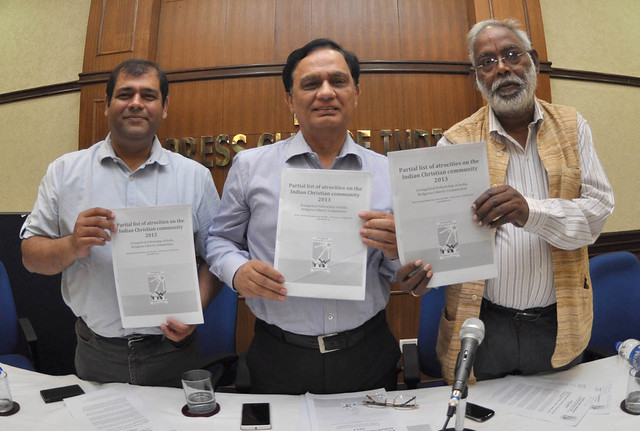
General Secretary the Evangelical Fellowship of India, Rev. Dr. Richard Howell and Religious Liberty Commission Secretary Rev. Vijayesh Lal held a presss conference today in Delhi to release the 2013 partial list of violence meted out to the minority Christian community across the country.
As many as 154 incidents of anti-Christian violence were reported in the year, with Andhra Pradesh registering 42 cases, Chhattisgarh 28 and Karnataka 27. Karnataka had been wrecked by extreme violence during August and September 2008 in the wake of the pogrom against Christians in the Kandhamal district of Orissa.
This list does not include large numbers of cases reported from Madhya Pradesh, Maharashtra and Rajasthan, which could not be immediately verified as being motivated by religious prejudice. These include at least three cases of murder, including one of a child of a pastor in Rajasthan.
The Evangelical Fellowship also received a very large number of complaints of structural and institutional violence from Rajasthan, Madhya Pradesh, Jharkhand and Gujarat. Most of these pertain to Tribals being deprived of their land f they convert to Christianity. In Gujarat, the computerized registration systems have been so engineered that Tribals have mandatorily to fill their religion as Hindu.
This is in violation of the Constitutional provisions for Scheduled Tribes. The matter is to be taken to the High courts of the respective states. The most shocking aspect of the anti-Christian violence is the targeting of women. This emerging pattern of violence is seen with great concern by the Christian leadership. Christian groups now plan to bring this issue to the notice of national and state political leaders soon.
In one horrendous case on 12th September 2013, a Christian woman, Sanamma, a helper in Anganwadi School was caught by a mob of 40 people when she was inviting children to join the school after the summer break. The mob accused her of forceful conversion, beat her up severely and took her to a temple where they poured water on her as a form of religious cleansing and thereafter applied "kumkum" on her forehead, a sign of Hindu married woman. Local Christians rescued her later and took her to a hospital for treatment.
In another shocking case in Taragoan, Lohandiguda, Hindutva extremist activists forcefully took a Christian widow to the temple and tried to sacrifice her to the idols. Her daughter and relatives rescued the widow.
The Evangelical Fellowship, in association with other Church groups, has consistently demanded that the Central government enact suitable legislation to end communal and targeted violence. We had hoped that Parliament would pass the Prevention of Communal and Targeted Violence Bill in the last session. It did not happen. We hope that the government formed after the 2014 General elections will take it up in earnest.

Friday, March 14, 2014

Three convicted over India nun rape

A court in India has found three people guilty in connection with the rape of a Catholic nun in Orissa state in 2008.
The nun was raped by a Hindu mob in Kandhamal district, days after riots between Hindus and Christian there.
Riots began after a Hindu religious leader was shot dead.
Although left-wing Maoist rebels in the state claimed responsibility for the killing, hard-line Hindu groups blamed the minority Christian community for the death.
More than 30 people were killed in the violence and dozens of churches and Christian institutions were vandalised.
Police had arrested nine people in connection with the rape of the nun. One accused is still being sought.
On Friday, Judge Gyana Ranjan Purohit found Santosh Patnaik guilty of rape, and Gajendra Digal and Saroj Badhei guilty of molestation.
Patnaik was sentenced to 11 years in prison, while Digal and Badhei were each sent to prison for 26 months.
Six of the other accused were acquitted by the court in Orissa because of lack of evidence.
The Catholic nun, working with the Divyajyoti Pastoral Centre at Kanjemandi village, alleged that she was dragged out of a Hindu man's house where she had taken shelter along with a 55-year-old priest, Father Thomas Chellantharayil.
She was taken to an abandoned house where she was raped by a mob on 25 August 2008. She also alleged that she was paraded naked through the streets.
Hindu groups in Kandhamal had accused Christian priests of bribing poor tribes and low-caste Hindus to convert to Christianity.
Christians said lower-caste Hindus converted willingly to escape the Hindu caste system. 

Click here for source


Wednesday, February 26, 2014

BJP Going All Out to Woo Christians

Pursuing prime ministerial candidate Narendra Modi’s strategy of using development and corruption as the main poll plank without invoking the Hindutva slogan, the state BJP is making a vigorous bid to reach out to the Christian community ahead of the Lok Sabha elections.
The party is all set for an open interaction with the community leaders and intellectuals to dispel the negative image in their minds about the BJP.  The first of this interaction with the theme ‘BJP’s Vision for Christian Brethren’ will be held on Tuesday evening in Bangalore. Retired High Court judge MF Saldanha and retired IAS officer Lucas Vallatharai among others are scheduled to participate in the event.
State BJP leadership has invited its Deputy Chief Minister in Goa, Francis DSouza to use his goodwill at the interaction.  Former  minister Suresh Kumar will explain BJP’s commitment to secularism and programmes implemented by the previous BJP government for the welfare of the community.
General Secretary of BJP Minority Morcha, Kennedy Shantakumar told Express: “Christians are a highly educated community. The previous BJP government had launched several programmes for the welfare of this community. Former chief minister B S Yeddyurappa had for the first time allocated `50 crore for their development. He had also set up Karnataka Christian Development Council. The community has many prejudices and misconceptions about the BJP. We will try to remove them through open interactions with prominent leaders of the community.”
Similar interactions would be organised in regions where there  is a significant concentration of Christian population. “The Christian community has organised an interaction with leaders of all the prominent political parties at St Mark’s Cathedral in Bangalore on March 1. The BJP wants to understand the aspirations of the Christian community,” Kennedy said.
Kennedy pointed out at  the recent developments in Kerala, where orthodox Church leaders had appreciated Modi’s development agenda.
However, the party still has a long way to go in its endeavour. This was evident when Express contacted Lucas Vellatharai, who is one of the guest listed in the BJP’s invite. “Attacks against Christians and Churches had seen a rise during the BJP regime. There are many good leaders in the BJP too. But it is the writ of the lower level leaders that runs. It will be difficult to believe the BJP unless it severs its ties with hardcore Sangh Parivar,” he said. Vellatharai also said that he could not confirm his participation at Tuesday’s interaction as he has to attend another programme on the same evening. “I will turn up only if the other programme, which I have to attend, ends early,” he said.
Counting on Community
Christians constitute about 3.1 per cent of the state’s total population. The community is in a position to play a decisive role in Bangalore Central and Dakshina Kannada Lok Sabha constituencies. The BJP had fielded H T Sangliana, a Christian as its candidate from Bangalore North Lok Sabha constituency in 2004.

Click here for source

Sunday, February 23, 2014

The secret 'crusade'

Religion and violence cross paths again in small-town Andhra Pradesh as right-wing fundamentalists target the local clergy, allegedly to arrest conversions
On January 10, at around 8:30pm in Vikarabad, 69km from Hyderabad, a group of men knocked on Pastor Sanjeevulu’s door. They said they had come to offer prayers. When Pramila, the pastor’s wife, opened the door, she was struck on the forehead with an iron rod. The assailants then marched into the house and stabbed the pastor, repeatedly. He was beaten with clubs and hit on the head with the iron rod. The attack barely lasted 10 minutes but Sanjeevulu sustained severe injuries to his liver, spleen and intestines. Three days later, he succumbed to his wounds at the Yashoda Hospital in Hyderabad.
By the end of January, State police had arrested seven of the eight accused. All of them have been linked to Hindu Vahini, a right-wing organisation described as an affiliate of the Vishwa Hindu Parishad, with its State unit located in Hyderabad. G Sreenu, alias Rama Krishna, was identified as the leader of the group formed by youth from the Nalgonda district. He had been working at Hindu Vahini as a full-time pracharak for the last few years.
In December 2013, three other attacks on clergy members were reported in the same district. These four incidents have revealed a chilling pattern — the same modus operandi, the same right-wing outfit behind the attacks, conversions as the alleged motive. In what appears to be a series of planned attacks, churches in Andhra Pradesh are increasingly being targeted by right-wing assailants. In 2013 alone, the State witnessed 72 incidents of anti-Christian violence, with several more unreported, say local residents. According to a report released by Catholic Secular Forum last year, AP had the second highest incidence of cases of persecution against Christians after Karnataka. In total, around 4,000 Christians, were targeted, 400 clergy members among them. About 100 churches were also attacked. In Nalgonda district alone, more than 1,000 churches are now living in fear.
On December 29, at 11:45pm, four men came knocking at Pastor Nama Moses’s door in Narketpally town, Nalgonda. Suvartha, the pastor’s wife, opened the door, thinking it was an acquaintance. She was struck on the head with an iron rod and Pastor Moses was hit repeatedly and stabbed nine times — a chillingly similar sequence of events echoing the assault on Pastor Sanjeevulu. Nearly two months later in February, when BLink contacted Pastor Moses, he had survived the brutal attack but was in no condition to talk. “The pastor has been here for two decades now and I’ve never known such enmity. I don’t understand why we were attacked. He has never forced anyone to convert,” says Suvartha. Her daughters, she says, have been unable to go to school out of fear. And attendance at his church has dwindled. “A few of them were local youth,” says Suvartha, “and they had recently attacked another pastor as well.”
“People are afraid of persecution,” says Kavitha, a resident of Nalgonda town. “The pastor’s children were in the room when the attack happened. It was only the morning after when they got any help.” Four weeks ago, a meeting was held at the Church of South India — Kavitha’s church — to discuss the violence targeting the community. “There have been many attacks here,” Kavitha says, “but most of them don’t make news.” If aggressively campaigned conversions are being cited as the reason for the attacks, locals at least, dismiss the idea. “I was the first in my family to turn to Christianity 13 years ago,” says Kavitha. “Nobody forced me to. Nobody offered me anything in return. My mother was a staunch Hindu, she didn’t approve of it. But today my family has converted.”
“The attack on Pastor Moses might have been personally motivated,” says Nalgonda’s Deputy Superintendent Ram Mohan Rao. “G Raju, one of the group’s members, was known to have a personal grudge. Someone in his family had a bad experience two years ago and he had contacted Sreenu to do something about religious conversions.”
However, Pastor Talla Christopher was attacked on the same day as Pastor Moses in another village of the same district. And, in yet another incident in December, Pastor Neeladri Pal was also attacked. While the police have made some arrests, the accused have apparently revealed a larger, systematic plan of Hindu Vahini to eliminate members of the clergy all over AP. Pastors in other districts — Adilabad, Nizamabad, Medak — have also received death threats.
“There is no personal angle in these attacks,” says Father Sudhakar, pastor of Telugu Baptist Church in Warangal, who is involved in documenting anti-Christian atrocities in the State. “It is politically motivated and it is right-wing terror against minorities. Hindutva elements have been attacking in three ways — attacks on the clergy, implicating church officials in false cases of hate speech and demolishing churches and burning Bibles.” In 2013, he says, there was a 70 per cent increase in the attacks. This year has already seen four attacks. “We have also documented 22 false cases against pastors.”
In an election year, the threat to Christian minorities has acquired a serious political colour; various church associations have written to the CM seeking a ban on Hindu Vahini. MIM leader Akbaruddin Owaisi has also demanded immediate action against Hindutva elements in the legislative assembly.
“You know, it’s not only SCs, other communities have also started turning to Christianity,” says Kavitha, “and it has not gone down well.” The base is definitely growing, says Father Sudhakar. “We don’t call them conversions, 90 per cent of SCs in AP are Christians spiritually, if not on paper.”
Pastor Jayraj still doesn’t know why he was attacked. On August 9, 2011, in Narketpally, he was attacked by a 10-member mob at his home. He was hit on the head and left to die. “I’ve heard of Hindu Vahini but I don’t know what they do. I couldn’t identify them, they had masks on. The police never caught them.”
With the violence directed towards Christian minorities only growing, older, unsolved cases like that of Pastor Jayraj are being revisited to look for possible links to right-wing terrorism. “After Pastor Moses, other cases that were undetected have come to light,” says DSP Mohan Rao. “Cases from 2011, even 2009, are being reopened too.” Even as investigations are on, the fear of being attacked continues to haunt AP’s Christian community.

Click here for source

Friday, February 14, 2014

Attacks Against Minorities in India Increased Last Year

Attacks against India's minority communities, particularly Muslims and Christians, have increased in the past one year, US lawmakers were told today.

During this period, the US Commission for International Religious Freedom (USCIRF) received reports that communal violence and attacks against religious minorities increased in India despite its status as a pluralistic, secular democracy, USCIRF Commissioner Elliott Abrams told lawmakers.

"NGOs and religious leaders, including from the Muslim, Christian and Sikh communities, attribute the increase to India's upcoming 2014 general election and politicians' use of religiously divisive language, and they fear that incidents will become even more frequent as the general election nears and immediately thereafter," Abrams said during a Congressional hearing.

He said Christian NGOs and leaders had reported that Christians experience "more harassment and violence in states that have anti-conversion laws". He added, "In addition, India's record in investigating and prosecuting religiously motivated crimes remained mixed."

Testifying before the Congressional committee, Tehmina Arora from Alliance Defending Freedom-India alleged that attacks have been reported across the country over the past five years, though primarily concentrated in states where the main opposition BJP has been in power and where groups associated with it are active.

"Violence is fuelled primarily by non-state actors who are guided by the Hindutva ideology, which sees India as a Hindu nation, where religious minorities are second-class citizens," said Arora, who flew in from New Delhi for the hearing.

"India, in spite of its long tradition for religious tolerance, finds itself in the throes of religious fundamentalism and violence against religious minorities for the past few decades," she said.

Reports by faith-based rights agencies showed that Christians had suffered about 150 violent attacks on an average in the past few years, Arora said.

These attacks include physical and sexual assaults, murder and desecration of places of worship and graveyards, she said.

Click here for source

Wednesday, February 12, 2014

Christians, Sikhs lobby U.S. Congress to defend India’s persecuted

Washington, USA (February 10, 2013): According to certain media reports Indian Christians and Sikhs united last month to urge California Congressmen to support a House resolution that would make human rights and justice for religious minorities a priority in U.S.-India talks.
HR 417 is waiting on hearings in the U.S. House Foreign Affairs and Judiciary committees, which must approve it before it can come to the House floor for a vote. The annual talks, which President Barack Obama began in 2009, last took place in June 2013.
“This is a particularly concerning issue at the moment because India is going to elect a new prime minister in May,” said Pieter Singh, executive director of Sikh Information Centre and Advisor to the Organization for Minorities of India.
Singh said both candidates, Rahul Gandhi and Narendra Modi, are linked to past attacks on religious minorities, including Muslims, Sikhs, and Christians. Gandhi is the grandson of Indira Gandhi, who led a military assault on the Golden Temple, a Sikh holy place, in 1984. Modi has been accused of being complicit in the 2002 massacre of Muslims in Gujarat state, according to Agence France Presse. He is a member of the Bharatiya Janata party, a Hindu nationalist political group.
“This is where religious minorities in India are at the moment,” Singh said. “These two men are fighting to rule India and look at their records.” The union of Christians and Sikhs, was a “natural alliance” given their religious motivation to help the oppressed, he said.
In 2009, the U.S. Commission on International Religious Freedom (USCIRF) put India on a “watch list” for its inadequate response to anti-Christian violence in Orissa (now Odisha) in 2008, and the Gujarat killings of Muslims in 2002. In 2013, USCIRF’s annual report placed India in Tier 2 status, noting that Christians, Sikhs, and Muslims said intimidation and harassment had increased, especially in states with laws against “forced” conversions.
William Stark, International Christian Concern’s Regional Manager for South Asia, said most persecution in India stems from Hindutva, the ideology that to be Indian is to be Hindu and that other faiths are foreign. Authorities said Hindu extremists were part of the group that stabbed a Christian pastor to death on his doorstep in early January, Morning Star News reported.
Hindu extremists use anti-forced conversion laws, which makes it illegal to “induce” someone to convert, to arrest Christians because the interpretation of the word “induce” can include the promise of eternal life, Stark said. In 2013, the Catholic Secular Forum counted 4,000 offenses against Christians, including attacks on clergy and churches.
“Passing HR 417 means valuing peace and the preservation of human life over political gain, and supporting the resolution is one of the key ways Christians can act to relieve the oppressed,” Singh said in a statement.

Click here for source

Monday, February 10, 2014

Dalit Christians renew demand for scheduled caste status

KOLKATA: Despite their decades-long demand, the central government is yet to decide on giving scheduled caste status to Dalit Christians. The National Council of Churches in India (An umbrella organization of 30 churches in the country - feels that it is time the government addressed the issue and provided justice to them.
The community here considers the demand for SC status to Dalit Christians the "the longest struggle in independent India". The call surfaced once again as National Council of Churches in India observed its centenary celebration.
"Reservation should not be affected by religious status. Dalits who converted to Sikhism and Buddhism are given Scheduled Caste status. This is discrimination against Christians," said Sunil Raj Philip, convenor of NCCI centenary celebration.
Earlier last year, Prime Minister Manmohan Singh met Christian leaders and promised to resolve the issue, after Christians and Muslims protested in New Delhi demanding SC status to Dalit Christians and Muslims as recommended by Justice Ranganath Mishra Commission.
"There has not been any progress after that and we are awaiting responses from the government," Raj Philip said.
The government referred the issue to the national Commission for religious and Linguistic Minorities or Ranganath Mishra Commission in 2004. The commission submitted its report in 2007 and the report was tabled in the parliament in 2009. According to Raj Philip,12 state governments and Union Territories have recommended the issue of granting SC status to Dalit Christians. Responding to a petition filed in 2004 Supreme Court had also asked the central government for its response. But it is yet to respond to that," he said.
Meanwhile, the national councils of churches in the neighbouring countries have decided to start dialogues with administrations in respective countries to address the issues affecting Christians. "We will campaign for protection of human rights in all of the neighbouring countries. We will also try to provide help wherever possible. We will initiate dialogues with the administrations to reach a solution," said Roger Gaikwad, general secretary of NCCI.
NCCI has denied reports that the NCCI president and member churches endorse the leadership and candidacy of Narendra Modi. "NCCI, being the ecumenical body of member churches from different traditions, does not endorse any political party or leader," a statement said.

Click here for source

Friday, February 07, 2014

India: Court Asks Christians To Wait One Year To File For Divorce

The separation period required for a Christian couple to file a petition for dissolution of marriage by mutual consent will be one year, the Karnataka high court ruled on Monday.
The court disposed of public interest litigation relating to Section 10A (1) of the Divorce Act, 1869, (applicable to Christians) in the light of a 2010 verdict of a division bench of the Kerala high court.
The Kerala court had read down the ‘two years’ separation period in Section 10 A to ‘one year’ so as to bring the same in conformity with Section 13B of the Hindu Marriage Act, Section 32B of the Parsi Marriage and Divorce Act and Section 28 of the Special Marriage Act.
A division bench headed by Chief Justice DH Waghela noted that the Kerala court judgment has become the law of land in the light of an apex court judgment which says that any verdict of a high court holds good for the entire country unless the same is challenged in the apex court.
The bench also noted that the Centre, which was a respondent before the Kerala court, did not challenge the said judgment.
During the hearing, counsel for the Archdiocese of Bangalore said that the dissolution of a Christian marriage by divorce by mutual consent or by decree of court is not at all recognized by the Roman Catholic Church (RCC).
“But realizing that a ‘marriage’ could be brought about with underlying defects or shortcomings or other disqualification, the RCC has procedure for annulment of marriage. Annulment by church is the only way of termination of marriage recognized by the RCC,” he said.
The PIL was filed by Shivakumar, who challenged the norm under Section 10A of the Divorce act prescribing a two-year period prior to filling of petition for divorce by Christians.
The petitioner contended that a two-year separation period is arbitrary as the Special Marriages Act, the Hindu Marriage Act and the Parsi Marriage Act have a one-year separation period clause.
The Kerala high court had said: “Having considered all the relevant circumstances, we are of the opinion that the stipulation of a higher period of two years of mandatory minimum separate residence for those to whom the Divorce Act applies, in contra-distinction to those similarly placed to whom Sec 13B of the Hindu Marriage Act, Sec 32B of the Parsi Marriage and Divorce Act and Sec 28 of the Special Marriage Act would apply, offends the mandate of equality and right to life under Arts14 and 21 of the Constitution.”

Click here for source

Thursday, February 06, 2014

Hindu extremists accused of killing pastor in India

The gang that knocked on the door of a pastor’s home in Andhra Pradesh state and stabbed him to death earlier this month consisted of Hindu extremists, authorities said.

State police have arrested seven of the eight members of the Hindu Vahini group accused of attacking pastor Orucanti Sanjeevi on Jan. 10 at his home in Vikarabad, 64 kilometers (39 miles) from the state capital of Hyderabad, Area Deputy Superintendent of Police J. Ram Mohan Roa told Morning Star News. The other suspect is absconding, he said.

Pastor Sanjeevi, 48, succumbed to his injuries on Jan. 13.

“The key member of this module is Gandikota Srinu, alias RK, a full-time member of the Hindu Vahini, and these same people attempted to kill another pastor in Narketpally,” Roa said.

The Rev. Madhusudan Das of the Evangelical Fellowship of India said the Hindu extremists were upset about Christian growth in the area.

“The area where the pastor was killed was a strongly Hindu-dominated area,” Das said. “However, the church has seen growth as many people decided to follow Christ. The extremists harbored strong resentment against the pastor for the same reason.”

A large throng of Christians had besieged the state chief minister’s office on Jan. 14, protesting the killing and demanding justice, with police detaining some of the protestors.

At about 8:30 p.m. on the night of the attack, the Hindu extremists knocked on the door of the pastor’s house, claiming they wanted to pray with him, sources said. When his wife, Pramila, opened the door, they hit her with an iron rod, they said.

The Hindu extremists then stormed into the house, stabbed the pastor, beat him with clubs and hit him on the head with an iron rod. His wife managed to run out and call for help.

“The pastor was lying in a pool of blood when some people came to help him,” area Christian leader Franklin Sudharkar told Morning Star News. “The attack lasted only about 10 minutes, but the pastor sustained severe injuries as he was stabbed in the liver, intestines and spleen.”

He was rushed to a hospital and put on ventilator, but he succumbed to his injuries at about 3 p.m. on Jan. 13.

Sajan K. George, president of the Global Council of Indian Churches, told Asia News that members of a Hindu extremist group had engaged the pastor in a heated discussion about three months ago and threatened him.

Pastor Sanjeevi had overseen the 250-member Hebron Church in Vakirabad.

The attack appeared to be well-planned, and police believe the extremists have made a hit list of targets, Roa said.

On Dec. 29, he said, the same Hindu extremists knocked on the door of the house of Baptist pastor Nama Moses in Narketpally, about 170 kilometers (105 miles) from Vakirabad, and attacked him in a similar way. The pastor opened the door thinking the person knocking was seeking shelter, said Moses Vatipalli of the All India Christian Council (AICC).

“One extremist with a knife barged into the house and started stabbing the pastor and the wife while two were standing outside,” Vatipalli told Morning Star News. “The pastor received nine stab wounds, and his wife sustained seven stitches on her head where the extremist hit her with an iron rod.”

The couple received hospital treatment for 15 days, and the pastor was still on bed-rest at press time.

Roa added that the assailants “held grudges against the Christian couple, as his grandparents started attending Christian meetings regularly.”

In the same area on Aug. 9, 2011, masked Hindu extremists attacked pastor Jaya Raj and an unidentified church member at midnight at the pastor’s home. The assailants broke Raj’s left hand and broke his nose, and the other Christian sustained severe injuries to his head, reported the AICC. Both of them received hospital treatment.

Wednesday, February 05, 2014

Christians below political radar: Council ‘Contribution overlooked’

Calcutta, Feb. 2: Christians in India have not been included in the mainstream political discourse despite substantial contributions to society and sustained efforts in nation-building, a national council of Protestant churches said today.
“Some people still think we are not Indians…. Christians are not present in the political discourse of mainstream parties today. Despite helping give the country some of the finest schools, colleges and hospitals, our efforts in nation-building and contributions towards society have been overlooked,” said Bishop Taranath S. Sagar, president of the National Council of Churches in India.
Kicking off its year-long centenary celebrations from Calcutta on Sunday, the council also referred to the Bengal government’s decision to provide doles to Muslim clerics. “If the government is handing honorariums to Muslim clerics, I would request the chief minister to also extend the honorariums to Christians as well. This act (giving doles to one particular community) is simply pleasing a section of society for votes,” Bishop Sagar said in response to a question after a news conference at Calcutta Boys’ School in the afternoon.
The Mamata Banerjee government gives an honorarium of Rs 2,500 a month to imams and Rs 1,000 a month to muezzins in Bengal.
The council is an ecumenical body of 30 Protestant and Orthodox churches across India and a slew of Christian councils and organisations.
It is the second largest body of churches in the country and includes the Church of North India and Church of South India as member churches. Nearly 50 per cent, about 12 million of the total Christian population of 25 million in India, are Protestants.
Calcutta was chosen as the first stop in a series of countrywide celebrations because on February 2, 1914, it was at the YWCA (Young Women’s Christian Association) building on S.N. Banerjee Road that the body held its first meeting and formed a council.
The celebrations will move to Aizawl, Hyderabad and Mumbai among other cities in the coming months and culminate at the headquarters in Nagpur in November.
As the centenary year coincides with the Lok Sabha polls, the council articulated its concerns. The existing political establishment, it felt, had failed to acknowledge or address the needs and aspirations of the Christian community and largely overlooked its contributions to the nation.
The council lamented that the term “minority” had become synonymous with just one community, overshadowing the others.
“If we look historically, Christians are the true minorities… but today (the word) ‘minority’ has become attached with just one community. There is no Protestant representation in Parliament from West Bengal,” said Suman J. Biswas, vice-president of the council.
Accusing politicians of consistently using religion for political gains, the council rued how issues like poverty had remained sidelined and religious minorities had rarely been acknowledged as anything but a vote bank.
Speaking on the community’s preferences for the upcoming elections, the Bishop said in response to a question that Christians were “highly divided” in their opinion on Narendra Modi.
“Modi played the development card in Gujarat and is playing the same card nationally now. But even if he becomes the Prime Minister and acts secular, he might face pressure from the lower cadres of the party. We are highly divided in our opinion of Modi and I cannot make one general statement on behalf of the Christians. Christians have traditionally been followers of the Congress… but it might be time for some change,” Bishop Sagar said.
He added that the council did not “endorse any particular party”. “We need a leader who is strong and understands the needs of the minorities and works for grass-roots development,” the Bishop said.
The theme of the celebrations “towards integral mission and grassroots ecumenism” was explained as one that was aimed at motivating people to go back to the grassroots of the society and work towards its development.
“In recent times, the development of the country has only been measured by political parties in terms of bridges, high-rises and metro rails. Grassroots development of the marginalised has remained neglected and that is why growth has not been uniform,” said Reverend Sunil Raj Philip, the executive secretary of the council.
The news conference was followed by a worship service at St. Paul’s Cathedral in the evening.

Click here for link

Tuesday, February 04, 2014

MP Christians fast for stable govt post elections

Bhopal: Around 70-80 members of Christian community began their 72-hour-long fast at a church in Govindpura area here praying for stable government at Centre post elections.


The members representing different denominations began the fast last evening under Father Anil Martin.

The exercise is organised under the banner of National Prayer Alliance of Christian Community, which is undertaking similar fasts across as many as 72 districts in various parts of the country.

Click here for source